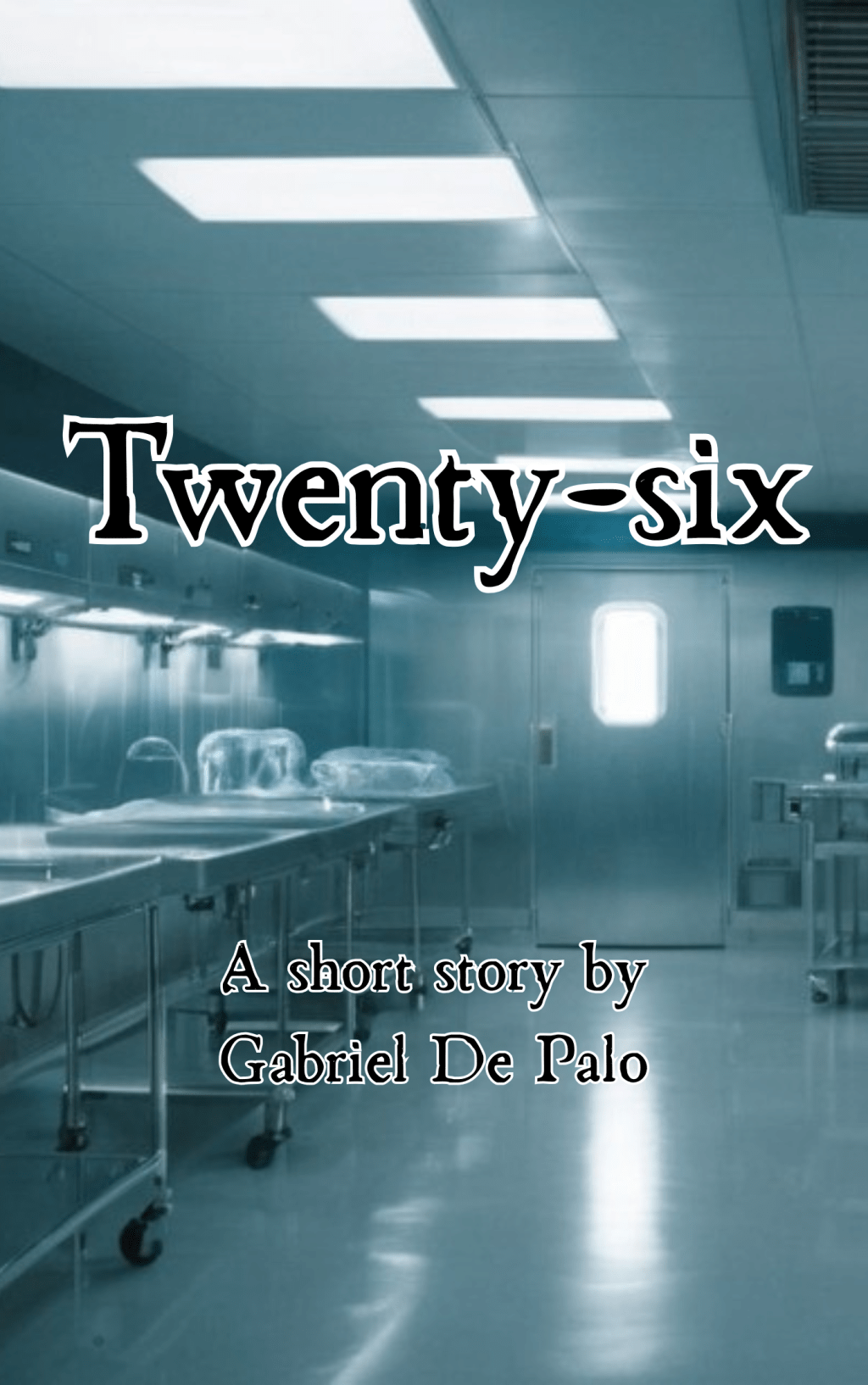
It’s finally my turn.
After waiting in line for weeks on end, it’s my turn to be cured.
The line for the facility extends practically all the way around the city, everybody within the quarantine zone eagerly waiting for their chance to get out of this hell hole. Slowly, but surely, the city has been emptied out, the first thousand people to receive the cure being immediately allowed to leave and rejoin civilisation.
After this, I can finally see my wife again. Pregnant women were the second group to be called in for the cure, immediately after the children. I did try to find her through the quarantine fence each day after she was done, but unfortunately, she was nowhere to be found. I supposed that she was still in the external monitoring zone, to ensure there weren’t any complications with the cure. She’s probably free now, but if I try looking for her again, I’ll lose my spot in line. I’m not waiting another few weeks to see her in person again.
A man in a hazmat suit at the entrance to the facility roughly grabs my decaying arm and jabs a needle into it, drawing out a blood sample. I wince in pain, watching as the ugly, brown-tinted liquid is drawn out of my body and into a tiny vial. He rips the needle out, not bothering to cover the bleeding pinhole, and places my diseased blood in a rack with countless other vials.
“What’s that for?” I croak as the man shoves me inside without ceremony.
“Identification,” he answers, slamming the door behind me and leaving me there, standing inside of a room covered in white sheets, from the ceiling to the floor. A woman approaches me, also dressed in a hazmat suit, holding a binder and reading through it.
“If you’d follow me, please.” she requests, barely even looking up from the binder. I oblige, and she brings me through a series of closed-off hallways, the white sheets acting like a huge tunnel, cutting us off from the rest of the facility. I see the odd spot of blood on the ground, but other than that, the space is pristine. We arrive at an open room, and she stands aside at the doors, beckoning me to enter. I walk past her, quietly thanking her for the escort, and notice that she recoils from me, pressing her back against the open door. I don’t blame her. All of the sick look like walking corpses, and I’m no exception.
I emerge into a large room devoid of anything but a small desk, a mess of wires on the ground, and a massive machine installed at the back wall with more hazmat-clad people attending to it. A cold sweat forms on my brow, and I start feeling a little queasy looking at the thing.
At the core of the machine is a sleek, throne-like metal chair, with open leather straps on the armrests and lower down where someone’s feet would go. A bowl-shaped headpiece sits just above the chair, covered with diodes and wires that snake around the rest of the machine. It’s fitted with multiple sharp needles and spines attached to mechanical arms, with clear tubes flowing from vats on the ground nearby, which I assume are filled with the cure.
“The device is safe,” the woman behind me says in a tone that makes me realise she’s said this exact same thing countless times before. “It’ll sting a little, but the pain is worth it.”
“Do you really need all those restraints?” I mutter, and one of the people at the machine beckons me forward. I’m vaguely aware of the door being shut and locked behind me, but I don’t pay it much mind, completely focussed on the device before me. I walk forward, never taking my eyes off it.
“Alright,” the person says, making sure to keep his distance from me. “Just hop onto the seat, we’ll do the rest.”
“What exactly does this thing do?”
He looks at another member of the staff, who shrugs at him, before he turns back to me. “Once you’re strapped, you’ll be injected with the serum. The helmet partially inhibits your pain receptors, but it’ll still hurt, so you’ll be restrained for the entire duration.”
“That other woman said it would sting only a little.”
“She was lying.”
“Oh.”
“Please get into the chair. We have a lot of patients to get through.”
“Right,” I splutter, clambering up onto the steel throne. “Sorry.”
The chair is still warm from the previous patient, but still awfully uncomfortable. As soon as I’m seated, the restraints clamp closed over my wrists and ankles, and the bowl helmet lowers down onto my head, partially obscuring my vision. The man from before walks in front of me.
“In case of an accident, is there anyone we should contact?”
“What?”
“In case of accident, is there—”
“No, no I heard you, but what’s the risk of an accident? How many accidents have there been?”
He pauses for a moment. “The device has had a one hundred percent success rate thus far. There haven’t been any accidents.”
I raise an eyebrow. “Don’t you mean the serum?”
“Sorry, yes. The serum has had a one hundred percent success rate. In any case, contacts?”
“Right.” I tell him my wife’s name, address and contact number, and he scribbles it all down in his binder before closing it.
“Great. We’ll begin soon, sit tight.”
He walks just out of my vision, and I’m left with nothing to do while I wait. I look down, noticing a few scratches in the metal around where my fingers are. More than a few, in fact. The entire surface of the steel by my fingers is absolutely shredded, in direct contrast to the shiny, smooth surface of the rest of the chair. I begin fidgeting, my heart beating faster.
“Hey, so, on a scale of one to ten, how much is this going to hurt, exactly?”
There’s no response for some time, before someone speaks up. “About twenty-six.”
I give a half-hearted laugh. “If it’s that painful, why not sedate people before you do it?”
“The device was expensive enough as it is without getting an anaesthesiologist in here as well.”
“Speaking of the device, why not use regular restraints? Why have this big machine when you can just strap us to a bed and prick us with a needle?”
No one responds to that question.
“Anyone?”
I hear a sigh to my left, and then a whisper, which evidently comes out a lot louder than they wanted it to. “Hurry up and activate the machine, before he catches on.”
My heart sinks. “Catches onto what?”
The person makes a tsk noise, but again, nobody responds.
“Hey,” I say, struggling against my restraints. “I don’t want to do this anymore. Let me out. I have a right to refuse treatment!”
“We’re sorry, sir.” The man walks in front of me again, hands clasped behind his back. “We can’t let you out.”
“Yes, you can! I have my rights!”
“Not in this case. I promise, it’ll be over sooner than you think.”
I hear the device whir to life, and the needles close in on my body. I try to shrink back as much as I can, but I can’t do much against these restraints. “What does this thing actually do?” I shout.
“It eliminates the virus,” he responds, so matter-of-factly. The needles pierce my body and I scream, my nails raking against the metal. The pain is excruciating.
As the darkness creeps in at the edges of my vision, my last thought is of my wife’s face, and the terrible understanding that she sat in this very chair, screaming for me just as I now scream for her.
 A Forsworn Fantasy
What did you think about this?